In my clinical practice, I often hear seniors say they’ve stopped traveling because their standard walker is too heavy to lift into a car trunk or too wide for airplane aisles. This isolation is a major setback for physical and mental health.
A travel rollator must solve three problems: it must be light enough to lift with one hand, narrow enough for tight spaces, and sturdy enough for uneven cobblestones or airport terminals.
As we move, carbon fiber and “Euro-style” folding designs have revolutionized this category. Here are my top 5 picks for your next adventure.
1. The Lightweight Champion: byACRE Carbon Ultralight
At just 10.6 lbs, this is officially the world’s lightest rollator. It’s made from carbon fiber—the same material used in high-end racing bikes and aerospace engineering.
-
Why I Recommend It: Most rollators weigh between 18 and 25 lbs. Lifting 10 lbs is a night-and-day difference for a senior with limited upper-body strength. The “hidden” brake cables mean you won’t snag on luggage or airplane seats during boarding.
-
Pros: World-record lightness, shock-absorbing frame, sleek “non-medical” look.
-
Cons: Premium price point; the seat is functional but minimalist.
-
Best For: Frequent flyers and those who need to lift their walker independently.
2. Best for Smooth Maneuvering: Drive Medical Nitro DLX
The Nitro series is a “Euro-style” classic. The DLX (Deluxe) version takes the popular design and optimizes it for better steering.
-
Why I Recommend It: It features large 10-inch front casters. In a PT’s world, larger wheels mean a better “angle of approach” for thresholds and uneven gaps between a train and a platform. It folds side-to-side with one hand, allowing it to stand upright even when collapsed.
-
Pros: Very stable, luxurious padded seat, excellent steering radius.
-
Cons: Heavier than carbon fiber (around 17 lbs).
-
Best For: Road trips and navigating busy city sidewalks.
3. Best for Posture: Stander Let’s Fly Rollator
Designed in Sweden, this rollator is often cited as one of the most beautiful mobility aids in the world, but its true value is in its ergonomics.
-
Why I Recommend It: The handles are turned forward, which encourages the user to walk inside the frame rather than pushing it out in front. This significantly reduces back pain and improves balance. For travel, its rear-wheel suspension system acts like a car’s shocks, dampening vibrations from bumpy roads.
-
Pros: Elegant weld-free frame, built-in suspension, very comfortable faux-leather seat.
-
Cons: Slightly wider footprint than some compact models.
-
Best For: Seniors who suffer from back pain while walking long distances.
4. Best Budget Travel Option: VOCIC Z21 Foldable Rollator
If you need a reliable travel companion but want to save your budget for the actual trip, VOCIC offers incredible value.
-
Why I Recommend It: Despite its lower price, it doesn’t skimp on safety. It features a “one-second” folding mechanism and a low center of gravity that prevents tipping—a common issue with cheap, lightweight walkers. It’s FDA-certified and handles indoor/outdoor transitions surprisingly well.
-
Pros: Great price-to-performance ratio, includes a cane holder and storage bag.
-
Cons: Not as “smooth” on rough terrain as models with suspension.
-
Best For: Occasional travelers or those looking for a secondary “car walker.”
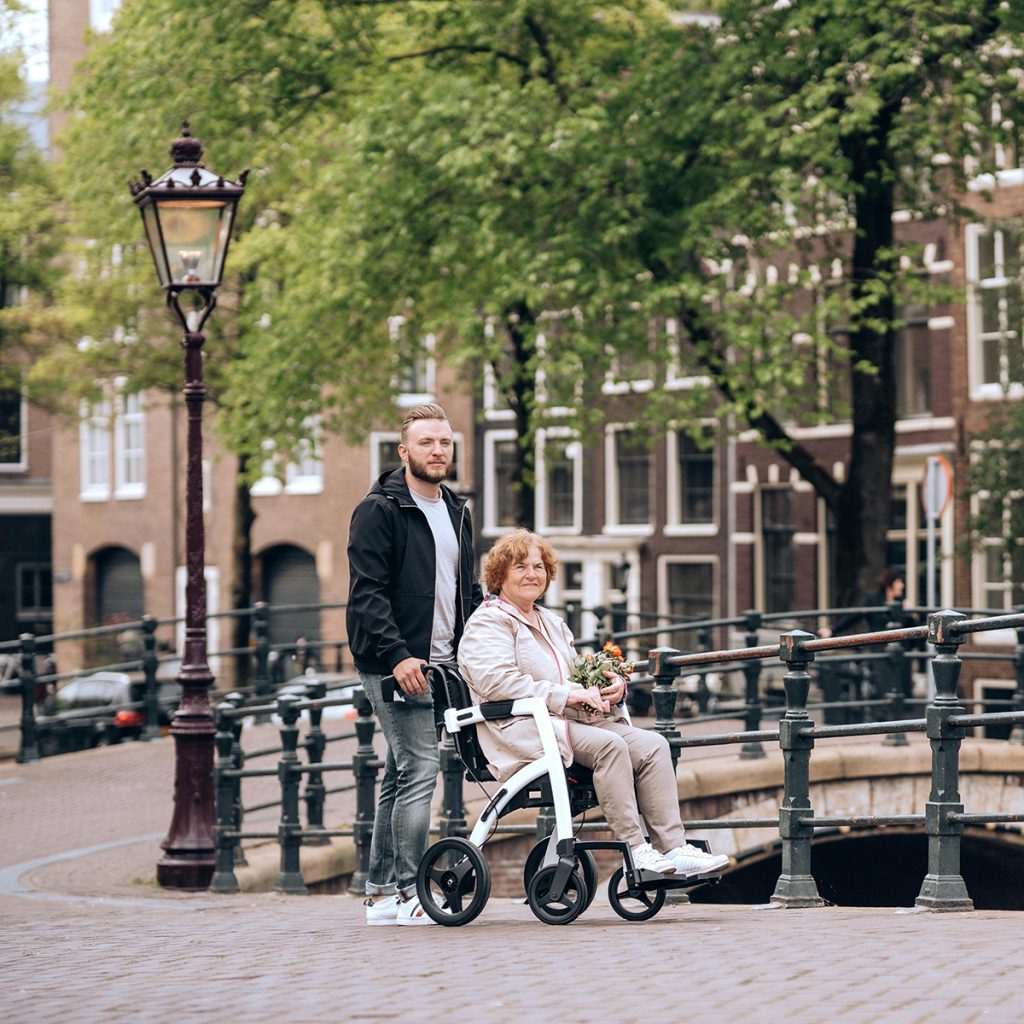
5. Best 2-in-1 Hybrid: Rollz Motion Performance
For some of my patients, they can walk part of the way but need to be pushed when they get tired. This is a rollator that converts into a transport wheelchair in seconds.
-
Why I Recommend It: Most “hybrids” are clunky and heavy. The Rollz Motion Performance uses air-filled (pneumatic) tires, which provide the softest ride possible. If you are visiting a place with cobblestones (like many European cities), this is the only model I recommend.
-
Pros: All-terrain air tires, converts to a wheelchair, highly visible reflective parts.
-
Cons: The heaviest on this list (approx. 24 lbs).
-
Best For: Cruises and international tours where long walking days are expected.
Joshua’s PT Travel Checklist:
Before you head to the airport, keep these three tips in mind:
-
Gate Check is Your Friend: You don’t have to check your rollator as luggage. You can use it right up to the door of the plane. The airline will take it and have it waiting for you the moment you step off.
-
Adjust the Handle Height: Your wrists should be at the same level as the handles when your arms are hanging naturally at your sides. This prevents shoulder fatigue during long walks in the terminal.
-
The “Curb Climber” Trick: Most travel rollators have a small lever near the rear wheels. Step on it to tilt the front wheels up—this is much safer than trying to “lift” the walker over a curb.
Travel Far. Stay Safe. Aging at Ease.
Disclosure: As an Amazon Associate, I earn from qualifying purchases. This helps support our mission to provide expert safety advice to seniors and their families.