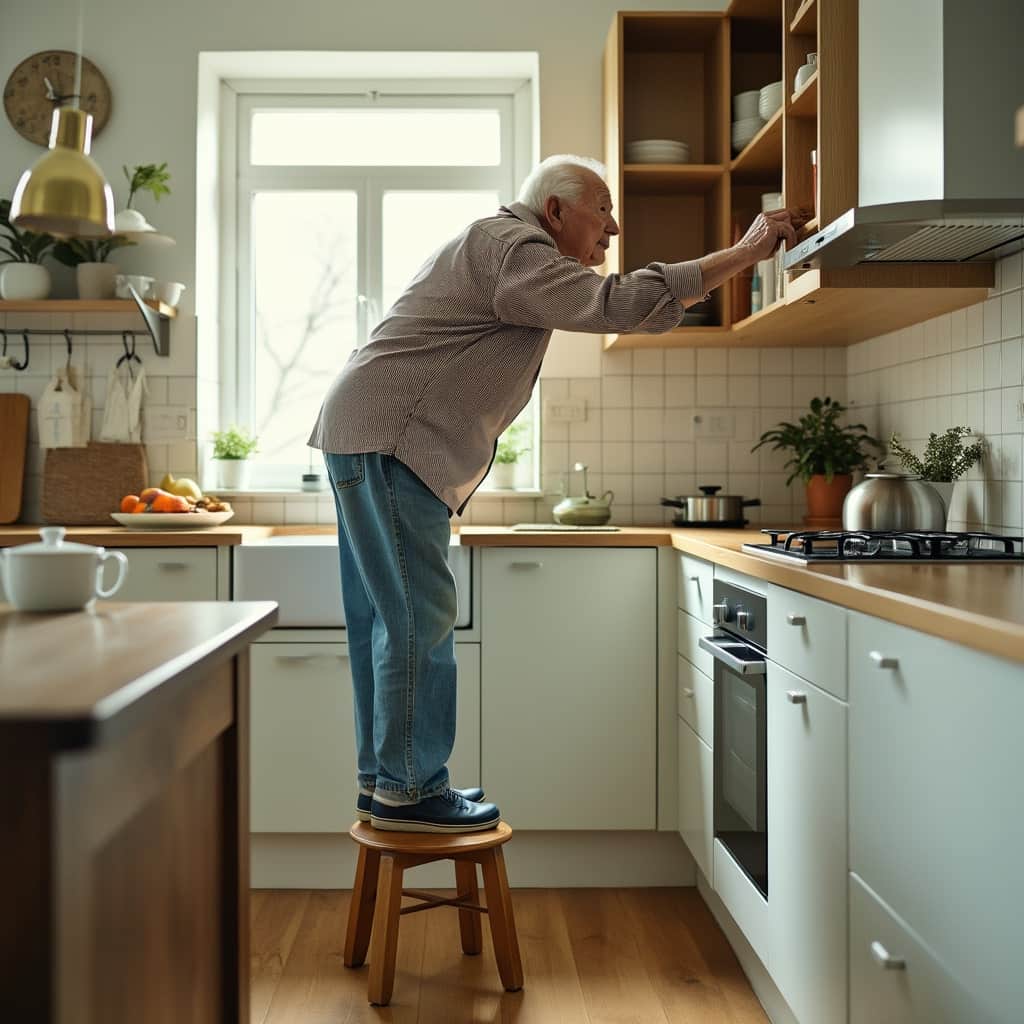

In my New York clinic, I often tell my patients: “Balance is a conversation between your eyes, your inner ear, and your feet.” When you have vertigo, that conversation becomes a loud, confusing argument. Whether it’s caused by BPPV (displaced ear crystals), Meniere’s disease, or vestibular migraines, dizziness is the leading cause of “preventable” falls in seniors.
We’ve moved beyond just “removing rugs.” We now use Vestibular Rehabilitation and smart home adaptations to recalibrate the brain’s balance center.
As a Physical Therapist, I’ve developed this 4-pillar strategy to help you stay upright and “Age at Ease,” even when the world feels like it’s spinning.
1. Master “Visual Anchoring”
When your inner ear (vestibular system) sends false signals of movement, your eyes must become your primary anchor.
-
The Strategy: Never move in total darkness. People with vertigo rely heavily on visual cues to know which way is “up.”
-
The Fix: Install Motion-Activated LED Lighting in every hallway and bathroom. If you wake up at night, wait 30 seconds on the edge of the bed for your “visual sensors” to lock onto the room before standing up.
-
PT Exercise: Practice Gaze Stabilization. Fix your eyes on a single letter on a post-it note at eye level. Slowly turn your head left and right while keeping the letter in perfect focus. This “re-trains” your brain to ignore false dizziness signals.
2. Create “Tactile Pathways”
If your eyes and ears are confused, your sense of touch (proprioception) must take over.
-
The Strategy: Your brain needs constant feedback from your skin and joints.
-
The Fix: Install Continuous Handrails in long hallways, not just on stairs. In the bathroom, use Textured Grab Bars (not smooth chrome) to provide better sensory feedback to your brain.
-
PT Tip: Avoid walking in socks or loose slippers. Wear High-Sensation Footwear—thin-soled, firm shoes that allow your feet to “feel” the floor texture. This sends clearer signals to your brain about your position in space.
3. Smart Assistive Devices for 2026
Traditional canes aren’t always enough for vertigo because they only provide one point of contact.
-
The Upright Advantage: As we discussed in our [Upright Walkers guide], standing tall is vital. Looking down at your feet while dizzy actually increases vertigo. An upright walker keeps your head level and provides forearm support, which creates a much wider “base of stability.”
-
The Tech Fix: Consider the BalanceBelt. This 2026 wearable device uses haptic (vibration) feedback to tell your brain when you are leaning too far in one direction, acting as an external “inner ear.”
4. Manage the “Transition Zones”
Most falls happen when changing positions (sitting to standing or turning a corner).
-
The “Stop and Stabilize” Rule: 1. Rise Slowly: Sit on the edge of the bed for a full minute before standing to allow blood pressure and the inner ear to equalize. 2. The 90-Degree Turn: Never “pivot” on one foot. Instead, take small “U-turn” steps. Imagine you are moving on a clock face—step from 12 to 3, then 3 to 6. 3. Avoid the Treadmill: If you have vestibular issues, the moving belt of a treadmill can trigger “Visual Vertigo.” A Stationary Recumbent Bike is a much safer PT-approved cardiovascular option.
Joshua’s “Vertigo-Proof” Home Checklist:
-
Contrast is Key: Use high-contrast tape (e.g., bright orange or yellow) on the edges of any single steps or floor transitions. This gives your eyes a clear “data point” to process.
-
The “Third Point” Rule: Whenever you are standing (e.g., brushing teeth), always have a “third point of contact”—lean your hip against the counter or keep one hand on a sturdy surface.
-
Hydration & Medication: Dehydration mimics vertigo. Also, review your medications with your doctor; many “dizziness” episodes are actually side effects of blood pressure or sleep medications.
Stand Firm. Stay Steady. Age at Ease.
Disclosure: As an Amazon Associate, I earn from qualifying purchases. This helps support our mission to provide expert safety advice to seniors and their families.
Read too: 5 Most Common Fall Hazards in the American Home: A PT’s Safety Audit