When patients come to my physical therapy clinic after a slip or a near-fall, they often tell me, “Joshua, I just feel like I can’t trust my feet anymore.” That loss of confidence is terrifying, and it frequently causes seniors to restrict their activities, staying indoors and avoiding social outings.
But here is the professional secret: balance isn’t a permanent physical trait—it is a reactive skill. Just like riding a bicycle, your brain can re-learn how to stabilize your body at any age. You don’t need a gym membership or specialized balance boards to fix it.
Your lower body contains hundreds of tiny proprioceptors (microscopic sensors in your muscles and joints that tell your brain where your limbs are in space). By challenging these sensors for just 2 minutes per exercise, you can significantly sharpen your reflexes. At Aging At Ease, we designed this fast, under-10-minute daily routine to strengthen your core, steady your ankles, and eliminate the fear of falling.
The 10-Minute Daily Balance Circuit
Safety First: For all these movements, stand next to a sturdy kitchen counter or the back of a heavy, non-slip dining chair. Keep your hands positioned roughly two inches above the surface so you can instantly grab it if you feel unsteady.
1. The Single-Leg Stance (The Foundation)
Time: 1 minute per leg
-
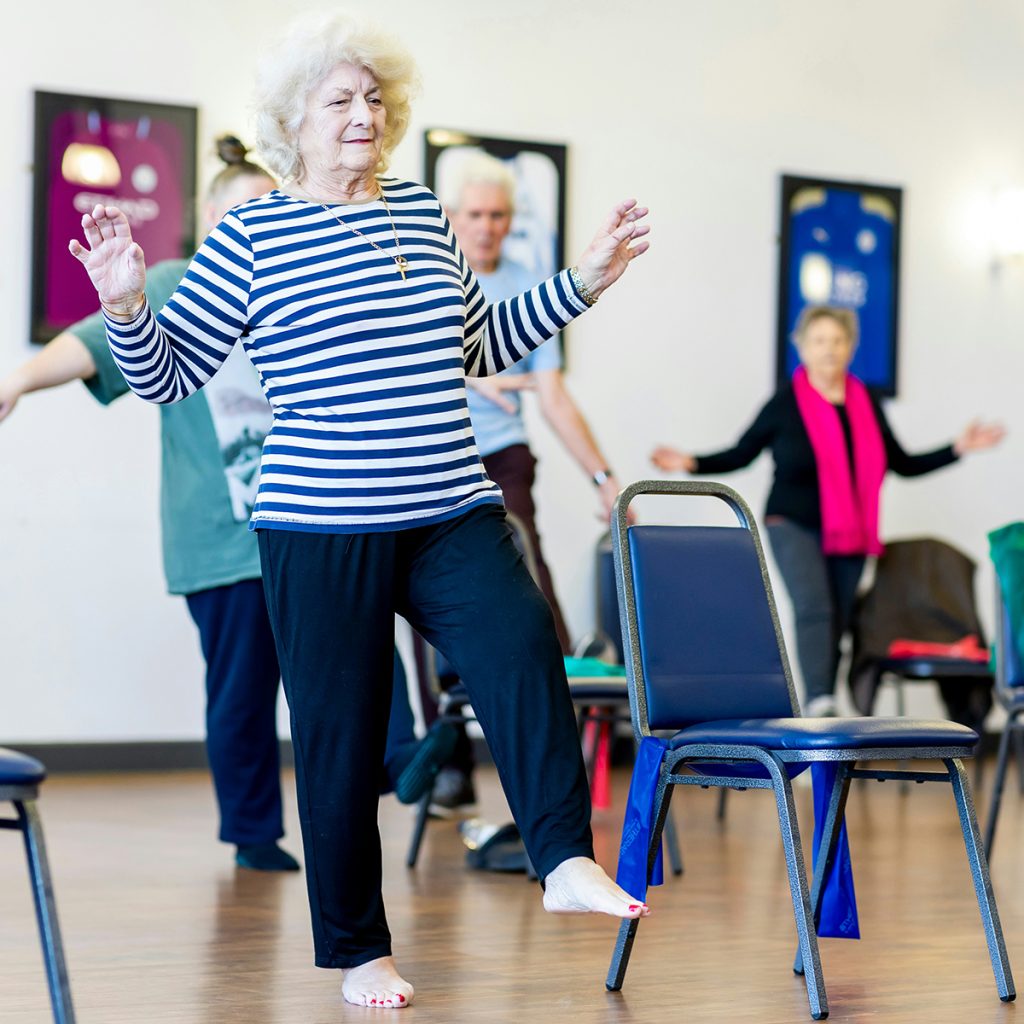
How to Do It: Stand tall with your feet hip-width apart. Lightly place one hand on your support surface. Shift your body weight completely onto your left foot, engage your abdominal muscles, and slowly lift your right foot a few inches off the floor. Hold this position for 30 seconds without letting your ankles wobble. Lower the foot, shake out your legs, and repeat on the opposite side.
-
Why It Works: This foundational drill shrinks your “base of support,” forcing the deep stabilizing muscles in your standing hip and ankle to fire rapidly to keep you upright.
-
Make It Harder: Once you can hold it comfortably, try hovering your hand just one inch above the counter instead of touching it.
2. The Clockwork March (Dynamic Weight Shifting)
Time: 2 minutes total
-
How to Do It: Stand behind your support surface. Imagine you are standing directly in the center of a giant clock face on the floor. 12 o’clock is straight ahead, 3 o’clock is to your right, and 9 o’clock is to your left. Lift your right foot and take a slow, deliberate step forward to 12 o’clock, briefly pausing with your weight shifted forward. Step back to the center. Next, step out to 3 o’clock, pause, and return. Repeat this rhythmic pattern using both legs.
-
Why It Works: Real-life falls rarely happen when we are standing still; they happen when we are stepping over thresholds or turning around. This exercise trains your brain to manage shifts in gravity during movement.
3. The Tightrope Walk (Tandem Tandem)
Time: 2 minutes total
-
How to Do It: Stand at the end of a clear, uncarpeted hallway near a wall you can touch for support. Take a slow step forward, placing the heel of your front foot directly against the toes of your back foot—exactly like a tightrope walker. Fix your eyes on a stationary spot on the wall ahead of you (looking down actually disrupts your internal balance centers). Take 10 steps forward, turn around, and return.
-
Why It Works: This drastically narrows your walking path, targeting your core and pelvis stability while correcting any side-to-side swaying tendencies in your gait.
4. Heel-to-Toe Rockers (Ankle Power)
Time: 1.5 minutes total
-
How to Do It: Face your kitchen counter and place both hands lightly on the edge. With your feet close together, press down into the balls of your feet and slowly lift both heels off the ground, standing on your tiptoes for 3 seconds. Lower your heels with control, then immediately roll your weight backward onto your heels, lifting your toes completely off the tile for another 3 seconds. Alternate back and forth.
-
Why It Works: Weak ankles are a massive contributor to tripping. This rocking motion strengthens the shin and calf muscles, which are responsible for lifting your toes high enough to safely clear rugs and uneven sidewalks.
5. The Assisted Sit-to-Stand (Functional Power)
Time: 1.5 minutes total
-
How to Do It: Sit on the front third of a sturdy dining chair (no wheels!). Keep your feet flat on the floor, hip-width apart, and pulled back slightly behind your knees. Bring your hands together in front of your chest. Lean your upper body forward slightly (“nose over toes”), press firmly through your heels, and power up into a full standing position. Pause for one second, then slowly lower your hips back into the chair over a count of three. Aim for 8 to 10 slow repetitions.
-
Why It Works: This is the ultimate functional balance exercise. It builds explosive strength in your quadriceps and glutes—the primary leg muscles required to arrest a fall if you trip over an unexpected obstacle.
Joshua’s PT Calibration Check:
To get the most out of your 10 minutes, evaluate your performance using this simple 1-to-10 effort scale:
| Effort Level | What it Feels Like | Physical Therapy Action |
| 1 – 3 (Too Easy) | You feel completely still; no muscle tension or swaying. | You are playing it too safe. Try lifting your hand completely off the supporting counter to trigger a balance reaction. |
| 4 – 6 (The Sweet Spot) | You feel a gentle wobble in your ankle, and your stomach muscles are actively tightening. | Perfect. This minor instability means your nervous system is actively working to build new pathways. |
| 7 – 10 (Too Dangerous) | You are flailing your arms, gasping, or constantly grabbing the counter to prevent a fall. | Regress the movement. Keep your fingertips firmly planted on the counter until your base strength improves. |
Train Your Reflexes. Rebuild Your Confidence. Aging at Ease.
Water Aerobics: The Best Joint-Friendly Exercise for Active Seniors
Disclosure: As an Amazon Associate, I earn from qualifying purchases of home health aids and fall-prevention tools. This helps support our independent physical therapy content library at Aging At Ease.